
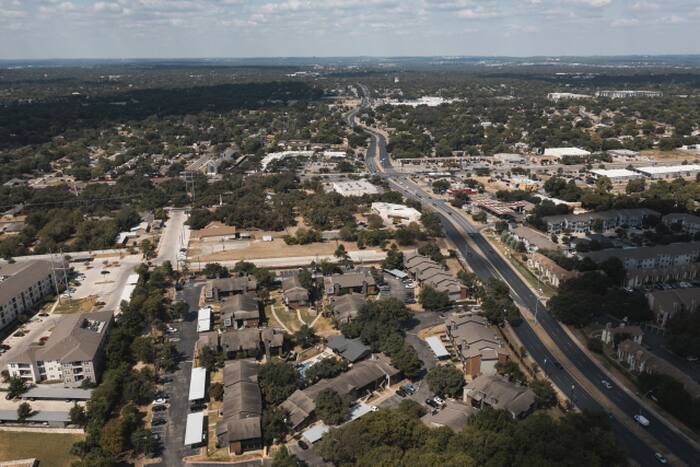
Texas’ booming suburbs have been a hard-fought political battleground for several cycles. How they vote in next week’s election could decide the state’s marquee races, including the U.S. Senate, and scores of critical legislative contests.
The suburbs of Texas have long occupied the middle ground between Democratic-dominated cities and dark-red rural areas where Republicans run up the score. But from Colleyville to Conroe to Cedar Park to Cibolo, that map is blurring, as once-rural areas become exurbs, exurbs become suburbs and inner-ring suburbs become economic powerhouses in their own right. Suburban counties are getting more populous and more diverse, and they make up a larger share of the electorate each cycle.
They’ve also been an anchor for Democrats, who’ve kept their numbers relatively stable in the suburbs since 2018 as the rest of Texas moved rightward. But that doesn’t mean the suburban counties behave uniformly, even within the same metropolitan areas.
In the Dallas-Fort Worth area, for example, Irving, a large inner-ring suburb west of Dallas, moved over 15 percentage points toward Republicans between 2020 to 2024, according to VoteHub — a much larger shift than the state as a whole. Plano, a suburb north of Dallas and farther from the city center, shifted only 6 points rightward, less than the state as a whole but still favoring Republicans. And Midlothian, a suburb south of Dallas on the outer ring, shifted nearly 9 points toward Democrats, while still voting solidly red overall.
Both U.S. Senate candidates first won elected office representing suburban state legislative seats — Ken Paxton, the Republican, in McKinney in 2002, and James Talarico, the Democrat, in Round Rock in 2018.
To flip Texas, Talarico and other Democrats will need to do more than just match their party’s prior high-water marks in these counties — they’ll need to post historic numbers in the suburbs, taking advantage of their growth and President Donald Trump’s poor approval rating. To keep the state under Republican control, Paxton and other members of his party must, as they did in 2024, hold the suburbs steady — or at least limit the anticipated leftward shift from spiraling out of control.
Hanging in the balance are competitive races down the suburban ballots across Texas, from the state Legislature to counties’ governing commissioners courts.
The Texas Tribune defined 16 counties as “suburban,” starting with the counties designated as “large fringe metros” — located in, but not central to, metro areas of 1 million or more people — in the National Center for Health Statistics’ 2023 urban-rural classification scheme. We then filtered out any counties with populations under 50,000, as well as ones that surpassed the 50,000 threshold but did not contain at least one city, or part of a city, with a population of 25,000 or more. The aim was to capture only counties with some degree of the density associated with suburbs, weeding out the more remote or sparsely populated exurbs and rural areas.
This method means we aren’t accounting for the suburban parts of “urban counties,” such as the outlying communities of Harris and Dallas counties beyond the cities of Houston and Dallas. Take it as an analysis of the suburban counties, but one that does not grab every suburban resident.
We made one exception to the methodology, choosing to include Collin County even though it was classified as a “large central metro” — the NCHS’ label for the most populous urban counties. We included it among the suburbs due to its proximity to Dallas and Fort Worth and its widely recognized status as a suburban county in the larger metropolitan area.
The resulting 16 suburban counties vary by population, from Collin County’s nearly 1.2 million people to Rockwall and Hunt Counties, which have between 120,000 and 145,000. And their partisanship differs across the board. Fort Bend and Hays counties, for example, have narrowly preferred Democrats in recent cycles; some of the less populous suburban counties, like Parker and Comal, are deeply Republican. And Montgomery County, the sprawling home of places like Conroe and The Woodlands, provided the largest margin, by raw votes, to President Donald Trump of any U.S. county in 2024.
But some patterns are evident across the state’s suburbs. Below, we illustrate some of them, along with a zoomed-in look at what is happening in the Dallas-Fort Worth area — the epicenter of Texas’ relentless suburban sprawl.
Each election, Texas’ suburban counties are becoming a larger portion of the electoral pie.
In just eight years, the 16 counties we’ve classified as suburban grew from about one-fifth to nearly one-quarter of the state’s registered voter population, inching up each election cycle.
That growth is especially evident in the counties that contain more outer-ring suburban communities, and in the exurbs of the metro areas that comprise the Texas Triangle — Dallas-Fort Worth, Houston, San Antonio and Austin. Much of the population increase is fueled by people moving from elsewhere in Texas and from out of state.
Each of the suburban counties we’ve identified increased its number of registered voters by at least 30% since 2012. In Comal County, which is between San Antonio and Austin, registered voters increased by 83% from 2012 to 2024, the biggest jump among these counties.
It’s not just white soccer moms in the suburbs anymore.
Suburban counties are diversifying almost twice as fast as the rest of Texas. In 2014, people of color made up 40% of the population in the 16 counties. By 2024, they made up nearly half the suburban populace.
That diversification is reshaping some of the communities that will determine the 2026 election.
In Collin and Fort Bend counties, both of which are between 22% and 24% Asian, the voting patterns of the Indian American and Vietnamese American communities will especially shape local races. Nationally, Democrats tend to do better with Indian Americans while Vietnamese Americans tend to lean more Republican.
But in Texas, Republicans have made significant gains with Indian Americans and with Asian voters broadly, helping to stymie the leftward shift of counties like Collin and Fort Bend in 2024.
Democrats are hopeful they can do better with Asian Americans this cycle amid the economic frustration extending to virtually all corners of the electorate, as well as an increasingly viral wave of anti-Indian hate from GOP activists particularly in the Dallas-area suburbs.
These counties are also expanding as they grow more diverse. Some of the most pronounced examples are Hays and Williamson counties, which have both grown by over 23% between 2020 and 2025. That puts both Austin-area counties among the fastest-growing in Texas. Over that same period of time, the white share of the population dipped below 50%.
When Ted Cruz ran for Senate in 2012, he ran up the score in the Dallas-Fort Worth suburbs.
Take the six major counties in the metro area — Dallas, Tarrant, Collin, Denton, Rockwall and Wise, each divided in the maps above by their current state House districts. In 2012, Collin and Denton counties were an abundance of safely red seats, as were the Tarrant County districts outside Fort Worth’s blue core.
Dallas-Fort Worth election results by Texas House district
Shown are U.S. Sen. Ted Cruz’s margins of victory in the Dallas-Fort Worth region over his three Senate runs, divided up by state House district rather than precinct for better visibility. His support dropped in 2018 in suburban areas outside the urban core and stayed that way in 2024.
.graphic-header, .graphic-prose, .graphic-footer { font-family: “Open Sans”, Helvetica, Arial, sans-serif; max-width: 41.5rem; margin: 0 auto; } .graphic-header, .graphic-prose { margin: 0px; padding: 0px; border: medium; } .graphic-header { font-weight: bold; font-size: 18px; line-height: 21px; margin: 0 0 10px 0 !important; } .graphic-prose { color: rgb(33, 33, 33); font-size: 14px; line-height: 17px; margin: 0 !important; } .graphic-footer { color: #777; font-size: 12px !important; line-height: 19px; font-size: .75rem; margin: .625rem auto; list-style-type: none; padding: 0; } .graphic-footer li { line-height: 1.55; } @media (max-width: 768px) { .charts-grid { grid-template-columns: 100%; /* Switches to 1 column, making each item 100% wide */ } }
Six years later, the map looked very different. Cruz’s margin in Collin and Denton counties narrowed, and O’Rourke even won a district anchored in Plano. Territory in northwestern Dallas County — which includes suburbs like Addison and Farmers Branch — went from red to blue. And Tarrant County experienced major shifts.
In all, Democrats, riding on Senate candidate Beto O’Rourke’s coattails, flipped six state house seats in the region that year, all of which included pieces of the suburbs.
In 2024, Cruz ran more than 5 percentage points ahead of his 2018 campaign. But that shift came from other places. Collin and Denton counties stayed a similar shade of light red, while Texas as a whole moved right.
The coalition Texas Republicans built in the 20th century that came to dominate the state has always relied heavily on middle-class and upper-middle-class suburbanites.
Once many of the suburban counties turned red, they never looked back. Montgomery County, for example, has voted red in every U.S. Senate race in Texas since 1988.
But in recent years, some have broken the trend. Fort Bend County, southwest of Houston, voted for a Democratic Senate candidate in 2018 for the first time in 30 years — a pattern it has repeated in every Senate contest since.
Taken together, the suburban counties have stayed red. But the margin has shifted enormously. Cruz won the suburban counties by 33 percentage points in 2012. Just six years later, his margin had fallen to 15 points — a smaller victory that nevertheless proved critical, given that he narrowly lost the combined vote across Texas’ other 238 counties.
Party operatives attribute the change to a combination of growth — including millions of new people arriving from out of state — and, in some areas, frustration among longer-term suburban Republicans as the GOP has shifted from the Bush country club model to the party of Trump and MAGA.
“I think you are seeing people who were part of a Republican Party that saw itself as representing upwardly mobile, younger voters,” said Wayne Thorburn, who served as executive director of the Republican Party of Texas from 1977 to 1983. “These are all the people that Trump has lost.”
Barry Jacobs, a 62-year old attorney in Waxahachie, is one such voter. Prior to 2016, he had voted Republican in every election he had ever participated in. But he became dismayed by what he sees as the embrace of corruption among some members of the Republican Party and the push toward culture wars.
In 2018, he voted for Cruz. But in 2024, Jacobs voted for Democrat Colin Allred. And he says he’s voting for Talarico this year.
He suspects there are other center-right voters like him in Ellis County, south of Dallas, who are being turned off by the party. Culture war attacks — like claiming teachers are transitioning kids in elementary school — may be less effective in tight-knit communities in the outer suburbs.
“We have one high school,” Jacobs said. “Everybody in town went to that high school…[teachers] live in the community. Everybody knows them. It’s not like this is a bunch of blue-haired hippies from California who are coming to brainwash our kids. [They’re] our neighbors. They go to church with us.”
Every county we defined as suburban grew at a faster rate than the overall state between 2012 and 2024. Twelve of the 16 counties also shifted toward Democrats by a bigger margin than the state did as a whole, using the metric of Cruz’s initial Senate victory and his most recent one.
The trendline also demonstrates that the more a suburban county grew over that 12-year period, the more it shifted toward Democrats.
Most of these counties voted for Cruz in both elections. But their margin changed. In Galveston County, which had the lowest growth rate of the bunch, at 21%, the leftward shift was marginal. Allred only performed 1.3 percentage points better than Cruz’s 2012 opponent, Paul Sadler.
Kaufman County, meanwhile, nearly doubled in population, growing at the fastest rate of all the suburban counties. It shifted 20 percentage points toward Democrats between 2012 and 2024.
The biggest political shifts also belong to the two most populous suburban counties — Collin and Denton — which moved 26 and 24 percentage points toward Democrats, respectively.
The trend also extends to presidential elections. Between 2016 and 2024, Texas lurched to the right, with Trump improving on his prior margin. But in 14 of the 16 suburban counties, Kamala Harris outperformed Hillary Clinton.
Much of the changing face of the Dallas-Fort Worth suburbs owes to migration from other places in the United States — and in particular, California.
Six of the top ten out-of-state counties where people are moving from are in California. The other four include some of the largest cities in America — Phoenix, Chicago, Seattle and Las Vegas, respectively.
“Don’t California my Texas” has long been a rallying cry on the right. But there’s active debate over whether the Californians are importing the state’s liberal political philosophy, explicitly choosing Texas because of its differences, including its lower cost of living, or just relocating for work.
Exit polling can be an inexact science, but their findings suggest Republicans should not be so quick to diss California, or non-native Texans more broadly.
In 2018, CNN found O’Rourke narrowly won native Texans, while Cruz dominated with people who have moved to the state. In 2024, the trend was nearly identical; Allred won people born in Texas by four percentage points, while Cruz won transplants by 16 percentage points.
“What I see is people coming from other states want it to stay the way it is,” said Jill Tate, the president of Texas Federation of Republican Women. “Some of the long-timers are like, I’m just ready for a change.”


